
Wednesday, 16 October 2013
Can You See and Make Comments?

What Support Does Bainimarama Have?
 |
| Just guessing. |
It is difficult and probably impossible to gauge the level of support for the Bainimarama government and its prospects of winning the 2014 election.
Its opponents claim they have the support but there's no way of gauging this either. Votes cast in the 2006 election may be cast very differently in 2014.
"Navosavakadua" writing in the relatively well balanced anti-blog Fiji Today, thinks the PM is assured of 27% of the vote due to the "Stockholm syndrome," the condition that causes victims to identify with their captors. "If so", he writes, "what this means is that the highest vote he can hope for is 27% because the rest of us do not feel grateful to our captor." My view would be that with this supposed "bedrock" support —and the support that Navosavakadua does not acknowledge— the PM should be well over the 50% mark. But we are both guessing.
Surprised that 90% supported FB
What we do have is the occasional informal 'survey' such as the one made as a comment on my recent Ratu Joni posting. The writer said that when he was in his home town in the West, he was surprised that 90% of those he asked said they supported FB and his party. They mentioned stability, assistance to the poor, school fees and the elderly, infrastructure, the decline in crime and equality for all Fijians as their reasons.
There is also the regular news that one village, settlement or tikina after another says it will support Bainimarama. But, again, this may be, as his opponents claim, only because they hope to benefit from the Government's development activities. Once the road, bridge, telecentre or other benefits are in place, they may revert to their earlier loyalties. For the moment, all we can do is report what is being reported.
In the last week Government had support from the Yasawas that I reported on Monday
Now we have reports from Tailevu North, formerly a Speight and SDL stronghold, and Ba province.
Tailevu North
Three elders from Delasui and Navunisole villages and Namalata tikina in Tailevu North said they want the changes being brought about by the Bainimarama Government to continue because past governments had used favouritism as a weapon to gain the support of the people and to put in place changes for only some.
They wanted a new type of leadership; one that was truly people-oriented. “We the people of Namalata would like this leadership to continue and for that we will vote for the Prime Minister and his party to lead the country after the 2014 general elections,” Ratu Isaia said.
Mr Kalou said his people supported the new leadership displayed by the Prime Minister. “I must admit that we now have a leader that cares for all Fijians,” The "special treatments given only to some chiefs by past governments had ended. The Prime Minister had treated all Fijians equally and this, he said, “is the way forward the people of Navunisole. This is why we will vote for Prime Minister Commodore Bainimarama and his party for the new government during the 2014 elections."
Ratu Mikaele said he supported the words of Mr Kalou and Ratu Isaia and for his people they were receiving Government help; something that they were denied in past years. He said past governments had their own people to look after and the majority were left in the dark.Now we have a new political direction that had the support of the people. People in the rural areas now having access to clean drinking water, electricity and good roads. He said they were now also provided with good health care and quality education.
Ba Province
In Ba, people living in Tauvegavega and Koronubu settlements in Ba are reported to support the new constitution and Government initiatives to assist farmers. according to Minister for Social Welfare, Women and Poverty Alleviation Dr Jiko Luveni, who visited them last week. The Minister said that for the first time ever Fiji’s Constitution has incorporated social issues, the rights and interests of the persons with disabilities .. children and senior citizens."
Koronubu is a multicultural sugar-growing area with 765 sugarcane gangs, vegetable growers and dairy farmers. District advisory councillor Deo Sharan said the people in the settlement, where "everyone lives in peace and unity", support the new Constitution. They are grateful for the bus fare scheme, social pension scheme and government’s commitment towards addressing the plight of sugarcane farmers. "We support the Bainimarama government and we hope to see this government continue for the many years to come,” he said.
Tauvegavega Women’s Group president Mrs Kelera Drodro welcomed the inclusion of the rights of all Fijians, including women, in the new constitution. "Women contribute towards national development and it’s important that they read and understand the new Constitution. The new Constitution treats everyone equally and there is no discrimination based on race or gender. Everyone is seen equally and for the first time. This is really encouraging”.
Yes. They could just be trying to please the Minister, but ....
Tuesday, 15 October 2013
News and Comments Tuesday 15 October 2013
 |
| Add caption |

The new rate "is a good start because it will mean that those workers who are earning below that will actually get something". But many of the statistics used in the recent survey were outdated, and did not take into account the 2.5% increase in VAT, the 20% dollar devaluation, and the 30% increase in food prices. The Commerce Commission recommendation is based largely on the 2008-2009 Household Income and Expenditure Survey. “A lot has happened since then... Wages have not kept up with the cost of living.”
He said employers need to realise that they cannot expect people to be productive unless they are meeting their basic needs. Productivity should not only be defined and limited to human labour. “If the workers are being paid below the poverty line, productivity is meaningless. Until we get wages to a decent level, we cannot expect workers to be productive. It also depends on other factors as well like capital, the machinery that are being used, the environment of the work place and the culture of the company – all that add or subtract from productivity.” Fr Barr said he has written to Dr Reddy on his thoughts on the proposed wage rate.

ACP STANDS BY FIJI. The
African, Caribbean and Pacific (ACP) Group of States, stands by Fiji as
it charts its future under a new Constitution and elections next year
says the ACP Sugar Ministerial Group chairman Hon Satya Faugo speaking during a traditional ceremony prior to the opening of the the 13th ACP Sugar Ministerial Meeting in Sigatoka yesterday.
“We
(ACP) wish to take this opportunity to commend the bold and sustained
efforts made by the Fijian Government, under the leadership of Prime
Minister Voreqe Bainimarama to chart an ambitious and an all inclusive
economic and political agenda for Fiji,” he said. “Let
me assure you Hon. Prime Minister of the unifying support and
solidarity of the ACP sugar family in Fiji’s course towards a better
future.”Hon.
Faugoo is the Attorney General of
Mauritius. -- MOI.
Over 100 ministers and delegates from the African Caribbean and Pacific group of countries are attending this Ministerial Conference. The PM said the ACP countries needed support as they made the transition from the present preferential price arrangement to the new Economic Partnership Agreements, noting that for Fiji this support has been sorely lacking. He called for the continuation of the sugar quota system after the 2017 deadline. This FijiLive article provides more details. Click here.
FORTY-SEVEN FAMILIES HAVE HOME LOANS WRITTEN OFF. Loans totalling $395,000 were written off by the Housing Authority by these householders because they did not have the ability to repay their loans. Chairman Col. Mosese Tikoitoga said $285,000 of the $395,000 is being drawn from a government grant alongside $110,000 from Housing Authority provision. He said special conditions will apply to protect the intent of the assistance under the Social Housing Policy.
Saturday, 12 October 2013
The President's Fiji Day Address

HIS EXCELLENCY RATU EPELI NAILATIKAU
CF, LVO, OBE (Mil), OStJ, CSM, MSD President of the Republic of Fiji
My fellow Fijians,
Once again we are all celebrating Fiji Day – 43 years after our flag was first raised on Independence Day, 1970.
All over the country, families, friends and neighbours have gathered together on this holiday. I send my warmest greetings to you all.
Beyond our shores, Fijians are also celebrating. Because no matter where we are in the world, October the 10th is always a day to remember.
Tonight, we especially think of those Fijians serving the peoples of other nations…
Our peacekeepers and police officers in far-away places like Iraq, Liberia, South Sudan and on the Golan Heights, including those Fijians serving in other Armed Forces around the world, and our civilian volunteers working in schools, hospitals and clinics with our Pacific neighbours as well as those working in other countries further afield. More than ever tonight, we think of their sacrifice and commitment and pay tribute to their service to Fiji and the world. They may be far across the seas, but in our hearts, they are close to home and we pray for them and their safe return.
We also think of their families who are sharing that sacrifice – wives without husbands, husbands without wives, children without a parent, families separated for long periods.
However hard that separation must be, on this day of all days, you can be proud that your loved one is putting service to others first. Putting Fiji First.
However hard that separation must be, on this day of all days, you can be proud that your loved one is putting service to others first. Putting Fiji First.
Because that is the essence of Fiji Day. A time to put aside our individual concerns and think about our nation and what it means to us all.
What does it mean to be Fijian? Clearly, we have been blessed with beautiful surroundings, fertile islands and an ocean teaming with life.
It is the responsibility of every Fijian to nurture and protect our environment, which is coming under increasing pressure. Even the youngest Fijian can play their part. If you see some rubbish on the ground or a plastic bottle lying on the beach, pick it up and dispose of it properly. We all need to do a lot more to rid ourselves of the litter that is spoiling our landscape.
But just as important as our physical surroundings is the spirit of being Fijian, of thinking more about those things that bind us together and make us a nation.
As we all know, we have had our challenges in the past. But I believe that whatever differences have existed have been contrived rather than being innate.
Some people have tried to exploit our ethnic, religious and political diversity for their own purposes, to create suspicion and fear.
But that division has been rejected by the overwhelming majority of Fijians. Because they know that only with unity comes prosperity and a brighter future – every Fijian working together as One Nation. Putting Fiji First. Making Fiji Great.
One to one, Fijians have invariably got along very well together because we all share some basic values. We have big hearts, generous spirits and a capacity to forgive.
What we do best in Fiji, especially in times of trouble, is to care for each other. And the past year has given us yet another inspirational example of this as we rallied around those affected by Cyclone Evan.
We can only ever be worthy of our promise as a nation if we do care, if we take everyone forward with us and leave no-one behind.
That is why our new Constitution is so important and that is why I have asked you all to support it.
Because for the first time, we have a supreme law that declares every citizen a Fijian….that declares every Fijian equal…that guarantees ordinary people basic rights…that gives every Fijian child the same opportunity to get on in life.
For the first time, our two major vernacular languages will be taught as compulsory subjects in our primary schools. It will be the glue that binds us together as we move into a common future sharing our stories and experiences.
And for the first time, any Fijian child can grow up to be where I am sitting now – to be the Head of State of Fiji.
Since I have been your President, I have visited 121 secondary schools in Viti Levu, and have personally spoken to more than 55,000 young people about HIV/Aids. I intend to visit the remaining 54 secondary schools around the country over the next few months.
I regard these visits as one of my most important duties to spread the message of achieving the universal access targets of HIV prevention, treatment, care and support and aiming to reach zero new HIV infections, zero discrimination and zero related deaths thus keeping our young people safe.
But it is also an extraordinary privilege to spend time with these impressive individuals who will take our nation forward, and on whom our collective hopes depend.
I can tell you – because many of them tell me – that they want to forge a new, inclusive future for our country.
We must embrace their optimism, their patriotism and passionate belief in unity and lay the foundations for a new Fiji, a better Fiji, with opportunity and justice for all.
Our new Constitution has finally given us a blueprint for that future. And before next Fiji Day, it will take us to the first genuinely democratic parliamentary election in our history.
In that election – before October 2014 – the vote of every Fijian over the age of 18 will have equal value. The vote of every Fijian will count.
Of course, the coming months are bound to be testing. That is to be expected. After all, we are doing something as a nation that we have never done before.
I appeal to everyone to approach the 2014 election in a spirit of goodwill. And to put the welfare and the stability of the entire nation above all else.
I ask our politicians to concentrate on producing constructive policies to take Fiji forward rather than looking backwards and engaging in destructive personal attacks.
I ask every voter to think for yourself what is best for you and your country rather than simply being led.
For the sake of Fiji, exercise your choice wisely in the interests of your own generation and for the generations to come.
And now, in the forty third year since Independence, and after three previous Constitutions, we finally have a document on which to build One Nation, One Fiji.
We have the opportunity to conduct an election based on best practice that is free, fair and credible, and that is enjoyed by other countries in the world.
And in doing this, we have the opportunity to finally join the ranks of the great democracies of the world.
And thus we have the opportunity of fulfilling the dreams of those of us old enough to remember Independence Day 1970 – of Fiji as a thriving economic powerhouse and a beacon for our neighbours.
On Fiji Day 2013, may God bless us all in our efforts to become a better, fairer nation.
May God Bless our beloved Fiji.
Thank you, Vinaka vakalevu, Shukria, Bahoot Dhanyavaad.
Shortlink:
 Posted by newsroom on October 11, 2013. File
"Fresh Policy Needed in Relations with Fiji"

the copy on the left, to read the article.-- Croz Walsh.
http://www.stuff.co.nz/dominion-post/comment/columnists/9259834/Fresh-policy-needed-with-Fiji
Lockington's Everyday Fiji ... Life Goes On
 |
| This is NOT the group complained about. |
There is still some concern with churches and homes where very loud religious gatherings are happening.
This is not a new issue. Now a radio host is concerned because she is awakened at 4 a.m. when the preaching starts to blare out from powerful speakers. Four a.m. is when people are in deep sleep and to disturb someone's good sleep is tantamount to a criminal activity. She said that she complained to the police but the loud preaching still goes on. Do churches have any respect for the neighbourhood who do not wish to worship at such an ungodly hour?
An honest hard working person, and even one less honest and active, needs a good night's sleep. We talk about being healthy and the importance of sleeping normal hours, but tolerate this bloody religious group that is causing a backache and a lower ache as well.
All I can say is that some denominations seem to think that shoving their religious doctrine down people's sleeping throats by yelling in the middle of the night will attract more followers.
Allen Lockington is a self-employed customs agent and business consultant who has regular articles published in Fiji. I thank Allen for permission to reprint some of them in this political blog. They remind us that life goes on, whatever the political situation. And it's good to know that.
Friday, 11 October 2013
Fiji Day 2013 Plus One (and More)

By Crosbie Walsh
Reflections on Fiji Day, post-Independence Fiji and today.
The parades, salutes, messages and
speeches are over for another year and it is time to review these
signals from Fiji's National day.
Congratulatory messages were received
from a host of nations, including the USA, but the event seemed to
have passed unnoticed in Australia and NZ. Not even ABC's Pacific
Beat or RNZ International had a mention. But there was one exception:
NZ's
online Scoop paper published an article by self-exiled Ratu Tevita
Mara in which, among other things, he referred to a "murderous
Bainimarama" (surely a libellous offence) and claimed his
brother-in-law, the President, had not wished or been able to address
the nation on this special day. In fact, summaries of the
President's speech were published by most Fiji papers, it was
broadcast live, and the full speech can be read on the Government
website.
His further claim that Fiji's "media is totally
controlled" sits strangely with the publication, by the
supposedly pro-Bainimarama Fiji Sun, of highly critical comments of
Government by Mahendra Chaudhry, of which more below, but I liked
Ratu Tevita's apoclypsic references to an "evil dictatorship",
"barrel of a gun" and a "reign of terror." They were so original.
Prior to the day
Prior to the day, longstanding
Government critic Shamima Ali of the Women's Crisis Centre
"called on all the citizens of
Fiji not to forget the true meaning of independence [and] the
importance of accountable democratic governance." Fair enough,
but her reminders to Government on health services, social welfare,
education, the disadvantaged and women seemed a little hollow, given
that this government has probably done more on these matters than any
previous government.
There could also have been stings in
the tail of the message from Methodist Church President, Rev. Dr.
Tuikilakila Waqairatu. His call for "liberation from oppressive
structures" and the need for "leaders who empower the
people rather than ruling them" was ambiguous, to say the least.
But is was good to see him calling for respect for different
ethnicities and cultures, and a "just, compassionate and
peaceful society." These are very different positions from those
of previous church leaders.
On the day itself
On the day itself, the Fiji Times
reported that "hundreds" had attended the Albert Park
celebration while Fiji Broadcasting reported "thousands",
and the Fiji Sun editorial called for the promotion of greater
tolerance and social harmony.
President Ratu Epeli Nailatikau (Ratu
Tevita's brother-in-law!) called on people to put aside their
differences, which he considered more contrived and manipulated that
innate, and rejected by the overwhelming majority of Fijians. He
said Fiji's post-Independence history showed
the country can overcome challenges,
and pointed to the 2013 Constitution as the way forward. For the
first time, he said, we are all Fijians, we have guaranteed basic
rights, and the two vernacular languages are being taught in schools.
FLP leader Mahendra Chaundhry told the Fiji Sun the
nation had regressed and had "little to celebrate." At Independence in 1970, he said, "We had a
parliamentary democracy with a constitution that guaranteed our
people their basic human rights and freedoms and fully protected the
interests of indigenous as well as other communities."Today is a
"sorry picture of a nation in distress" with "little
hope" of credible elections, or a "return to the liberties
and freedoms we enjoyed at the time of Independence 43 years ago."
It is understandable, as people get older, that their views of the "good old days" get distorted. Mr Chaundry has clearly forgotten his many speeches
on land, leases and racial inequalities adversely affecting the
Indo-Fijian population, tens of thousands of whom have emigrated
since Independence.
The United Front for a Democratic Fiji
(SODELPA, FLP, NFP, - a revived UPP that Mike Beddoes had previously
declared defunct - and the FTUC) were similarly unenthused, claiming
that people's rights continued to be abused, and called on the public
to "look behind the headlines of the regime's media support
group, see what was really happening, and not be so gullible."
Interestingly, some have argued that the SDL before its reincarnation
as the SODELPA relied heavily on voter gullibility to keep it in power.
My take
My own take on Fiji's achievements
since Independence is that the country has fared far better than most
former colonies of comparable complexity. There have been no civilian
deaths for political causes; the judiciary has remained independent, though both the Qarase and Bainimarama governments shortened some of
its prison sentences. Arrests, imprisonment and torture have been
limited, of short duration or minimal, other than Speight's kidnapping of parliamentarians, his alleged
torture of Chaudhry and the abuse of NGO women in 2007, in which,
please note, Ratu Tevita Mara was directly involved. And
restrictions on some human and political rights have affected
the urban vocal classes far more than ordinary people who are more
concerned about basic livelihood than speaking rights.
The relative moderation, shown in all
the coups, is a credit to the basic decency of all Fijians, and the
element of "idealism" that was wrapped up with the less
noble purposes that brought about each of the coups. Rabuka was not
totally convinced about ethno-nationalism; Speight's hidden
supporters had mixed feelings about his actions; and Bainimarama did
not start a coup to prevent his arrest.
The 2006 Coup and today
The 2006 coup started as a rejection of
proposed Qarase legislation on immunity for the 2000 coup plotters
and the Qoliqoli Bill, and as a "clean up" campaign on corruption, then considered "rampant" according to The Fiji Times.
It
progressed to wide community involvement during its People's Charter
phase (opposed by most old politicians); took a step backwards (with
help from its opponents) after the 2009 Court of Appeal decision and
the abrogation of the 1997 Constitution; moved forward to the
setting up of the Ghai Commission (despite the early opposition of
the old politicians); and took another step backwards due to the
unacceptable transitional clauses of Professor Ghai's draft
constitution (applauded by the old politicians).
It is now poised
to move forward again with a basically sound constitution and
elections in 2014 (opposed by the same old politicians who could still
derail the whole process). It seems the old politicians want
nothing more than to return Fiji to how it was before the 2006 Coup.
If, as I think, most Fijians want to
move forward, whatever the perceived imperfections of the 2013
Constitution, the old politicians are risking ongoing redundancy — which may not be a
bad thing if they don't make themselves more useful and relevant to
present realities. They could, for example, seek amendments to the
constitutional clauses to which they most object instead of
condemning the document out of hand. I think in particular of wider
representation in the Constitutional Offices Commission prior to the
elections, and more positive noises about election preparations.
They would also be well advised to reflect
on Ratu Tevita's "reign of terror" and thank God the chief
is delusional. Otherwise two former prime ministers and their
supporters would not be walking the streets of Suva. They would be
dead or imprisoned.
How fortunate they are to live in a Fiji that,
despite setbacks over the past 43 years and ongoing shortcomings, is
still afloat thanks to the wisdom of some of its leaders and the
tolerance of most of its people.
Thursday, 10 October 2013
FJII DAY 2013

https://my.tfl.com.fj/index.php?route=stream&stream=fijigovt
Saturday, 5 October 2013
Open List Voting: Dr Veramu on What Suits Fiji
 |
| Amnesty International consultant Dr Joseph Veramu |
So what can we expect when we go to the polling booth next year? “What will the ballot paper look like in September 2014?” some are asking.
Last week, Attorney-General and Minister Responsible for Elections, Aiyaz Sayed-Khaiyum said that drafting specialists will be in Fiji by next month to begin work on rules and regulations for the elections. This is expected to be made public by the end of the year.
Here, we take a look at what the ballot paper may look like. Civic education specialist, Dr Joseph Veramu provides two examples of what he thinks might be suited for Fiji.
Parliament numbers
The constitution makes clear that a 50 member Parliament will be elected from a single national constituency. We know that an “open” list rather than a “closed” list system of voting will be based on proportional representation meaning that parliamentary seats are based on the proportion of valid votes that a party gets.“In open list balloting, voters (NOT the political parties) choose the order of preferences of candidates. “The Constitution does not mention“preferential” voting which allows for flexibility in open list voting.”
Dr Veramu said the two models presented here are well suited to Fiji’s single national constituency since they will result in a truly proportional result.
Model 1
“The ballot paper for the first model will have all the parties registered to participate in the elections together with their respective lists of 50 candidates (listed in the party’s preferential order.)
“The voter votes for a party and may choose one candidate on that same party’s candidates list.
“While the votes received by the party determines the number of seats it gets in Parliament, the votes for candidates determines the order in which they receive seats allocated for the party.
Dr Veramu said this limited open list is widely used in Brazil, Colombia, Finland, Iceland, Indonesia, Japan, Latvia, the Netherlands, Norway, Poland and Sweden. (Although a “limited” open list system, it is nevertheless still an open list.)
Model 2
“The second model would have the names of all parties and their 50 candidates listed under them.
“The candidates’ lists’ (provided by the parties) will be ‘open’ in the sense that they are not priority or preferential lists in the order of selection to Parliament.
“They are alphabetical lists or random lists,” he said.
“Parties could be allowed to automatically select their party leader and deputy party leader.
“However in the event that a party wins three or more seats, the third seat would be chosen (from the list of 50 candidates) in terms of gender or multicultural or geographical representation.
“The Electoral Commission may at its discretion make a determination whether the name of the third successful candidate (and any successful additions that a Party gets) are based on the criteria provided.”
Disadvantages
“More and more people are expressing an interest in standing in the September 2014 elections.
“Social media like facebook is crowded with people who have become unusually friendly due to their upcoming candidature.”
Dr Veramu said this may mean a ballot paper looking like a table cloth if there is a kind of “free for all”. He said this could be alleviated if all candidates were asked to deposit say $10,000 each with forfeiture if they do not receive one percent of the ballots.
“In one European country, voters can ask only for the ballot paper of the party they wish to vote for, rather than the whole “table cloth” list.”
Advantages
Dr Veramu said in both models, seats are apportioned fairly between parties according to the numbers of valid votes they win.
“Fiji voters have the ability to override parties’ preferential lists.
“This gives voters more say over who is elected and thus result in the election process being seen as more legitimate.”
Based on a story by Rosi Doviverata in the Fiji Sun.
----
Dr Joseph Veramu studied at the London South Bank University (MSc) and the University of the South Pacific (MPhil & PhD). He has worked for the Commonwealth Youth Program SPRC, University of the South Paciic and the United Nations Development Program. Dr Veramu's interests are in learning, knowledge creation, ICT, governance and sustainable development
Treading in Moses’ footsteps: Fiji’s Fourth Constitution by Ratu Jone Madraiwiwi

http://www.constitutionnet.org/news/treading-moses-footsteps-fijis-fourth-constitution?utm_source=newsletter&utm_medium=emailratu Jone Madrawiwi
In promulgating Fiji’s new and fourth Constitution earlier this September, the country’s leaders hailed it as “the Constitution Fiji needed to have in order to join the ranks of the world’s great democracies”, and described the event in triumphal terms ranging from “historic” to “revolutionary.”
The document is certainly progressive in some respects: it provides, for instance, an expansive bill of rights with particular emphasis on socio–economic and cultural rights; an equitable and non-racial electoral system in place of the communal based systems as well as oversight institutions to promote transparency, accountability and combat corruption. It also creates a common Fijian national identity, which for the first time makes all citizens ‘Fijians’ irrespective of their ethnic identity. The Constitution also transfers the powers of the Great Council of Chiefs (GCC) to appoint the President to Parliament. Unlike before, this makes any Fijian, regardless of ethnicity more likely to be appointed to this office. In general, the removal of this institution, which—because of its exclusively Taukei composition—tended to favor members of this indigenous community, creates hope for more equal opportunities to all especially with the recognition of ‘Fijian’ as a single national identity. But is this enough to earn such glowing description or is the government just indulging in unwarranted self-praise?
Reaction to the document itself has been mixed, mirroring the political and ethnic divisions which remain a subtext of ‘post-revolutionary Fiji’. Government sympathizers have welcomed the document. Fiji’s closely regulated media is also accentuating its positive features lest it be sanctioned by the government through informal ways like limiting their access to official events, sources of information or, worse still, outright intimidation. The main political parties like the Social Democratic Liberal Party, the National Federation Party, the Fiji Labour Party, and the National Democratic Party, who see the document as a brainchild of the government, have opposed it - citing issues of legitimacy and principle. One need not look far to understand their position. To begin with, this Constitution, unlike the 2012 Constitutional Review Commission (CRC)’s version—which emerged from a more credible and participatory process but was summarily rejected by the government—is far from being a democratic product, having being drafted with little or no public input.
Further, it contains some disquieting provisions such as s.161 which grants the president powers to amend the document by decree if ‘ necessary to give full effect to [its] provisions or to rectify any inconsistency or errors in any provision [therein].’ Although only valid for the transitional period, such a provision opens the window for potentially abusive amendments during this period should the President be so inclined. This is all the more so because the Constitution, except for a vague safeguard requiring the certification of the Supreme Court, does not provide any objective criteria for determining what is (or is not) ‘inconsistent, or ‘erroneous’ suggesting that such a determination is predominantly the government’s call based on what it considers to be ‘inconsistent’ or ‘erroneous’. Could it use such a provision to erode gains made so far? By abandoning the recommendations from a Commission they set up and discarding the draft constitution it produced, Fiji’s leaders have sufficiently demonstrated that they are an unpredictable lot. Nothing can therefore be ruled out even within the short transitional period.
Other equally disturbing provisions include those granting unconditional and inviolable immunity to military leaders (s.159); giving extensive powers to the PM and Attorney General, disrupting the balance of power between the different arms of state (s.133); limiting political rights (s.6); shielding decrees from legal challenge (s.173), and expanding the role of the army (s.130). Not only do these run contrary to the government’s own non-negotiable principles that set the bar for a quality document, but also, they pose serious implications for the cultivation of a democratic culture and strengthening of the rule of law. Rigid amendment procedures, for instance, beyond preventing responsiveness to societal dynamics, also expose the document to extra-legal approaches to change.
Likewise, granting immunity to military leaders; as well as entrenching and shielding certain decrees and legislation (which were largely arbitrarily made), from judicial review raises serious issues of accountable and transparent governance especially where a need may arise to revisit circumstances that warrant redress or reparation.
In the same vein, limitations to fundamental political rights tighten the space for political participation. The negative potential of such a provision are already apparent, as the government sanctioned protests, albeit limited, that preceded the promulgation ceremony on 6 September
All these only allow for cautious optimism. The Constitution, as is, does provide a framework for democratic development, but which needs to be embellished further. The role of the new institutions established to enhance accountability and transparent governance, and the personnel running them, will be critical in this regard. The judiciary, which is central to this transformation, but has virtually been cowed into silence since 2006, will need to regain its voice and independence. However, whether or not the government will give it, and other actors involved in this democratic project, that free hand as the implementation of the Constitution commences, is anyone’s guess.
 C/Flickr/Public Services International
The potential for change, regardless of what factors drive it, brings a great deal of hope and expectations; which may generate a great deal of momentum that the government may eventually be unable to control. Like Indonesia and Myanmar before it, Fiji –viewed through this lens— also presents an interesting example. It is true that, in the Fijian case, the Government lost its nerve and eventually aborted the CRC process. Yet, it must be acknowledged that the whole experience itself helped shed light on what considerations can incline people to get involved. These include public dialogue and awareness, civil society mobilization and trust, built by some of the institutions involved —in this case the CRC, whose role was critical in getting major opposition parties on board. All these will have long-lasting and far-reaching consequences on Fiji’s democratic development downstream.
One reason for this conclusion is that the CRC process created space—albeit brief—for dialogue and engagement that was inspiring. As the elections draw closer and political activity and debate gather pace, there is cautious expectation that a similar scenario will develop. This is being shaped, in part by the transition from an arbitrary climate to one where constitutional legality, admittedly piecemeal, is crystalizing and prompting greater interest and participation from youths, women and civil society.
A second, perhaps, related reason is that while this Constitution is not perfect, it still provides the most practical and expeditious means of moving from arbitrary rule to more accountable governance. It must also be recognized that the Government, inadvertently or otherwise, incorporated some of the CRC proposals which have now become some of the strong persuasive points of this document. They include the bill of rights, transparency and accountability provisions. It is expected that the new ‘one man one vote’ or common roll system which does not differentiate voters based on ethnicity will defuse ethnic tensions which the communal voting system encouraged, and also help to build a strong sense of the newly recognized single national identity. The hope then is that over time, Fiji’s increasingly informed, vibrant, active, and more resilient populace will be able to capitalize on the limited gains of this Constitution and use it to bring about deeper and more desired transformational changes.
[1] Joni Madraiwiwi was Vice President of the Republic of Fiji (2005-2006), and is a traditional ruler and lawyer by profession.
Analysis by Paul Buchanan of 36th Parallel Assessments **
Analytic Brief: The Transition Tango in Fiji
Written by Paul Buchanan on Thursday, October 3rd, 2013
Analytic Brief: The Transition Tango in Fiji.
Paul G. Buchanan
 Fiji Parliament House. Photo courtesy of Jarred Wilshire, 2006 via Wikimedia Commons.
Transitions from below, or bottom-up transitions, are collectively organized mass mobilizations against the regime in power. Taken to the extreme, they can result in regime collapse or downfall. The ultimate expressions of these are social revolutions involving mass collective violence such as the Bolshevik Revolution of 1917, the Chinese Revolution of 1948, the Cuban Revolution of 1959, and the Iranian and Nicaraguan Revolutions of 1979.
The so-called Arab Spring provides other examples of bottom-up transitions, although like the revolutions just mentioned they do not necessarily end up in democracy. In fact, bottom-up transitions are more likely to see the replacement of one authoritarian regime by another rather than a democratic outcome. They can also result in a partial restoration of the old regime under new leadership. Tunisia, Libya, Egypt and Syria are examples in both regards.
Transitions from above, or top-down transitions, are those where the outgoing authoritarian regime controls the timing, pace and conditions governing a move towards elected rule. Usually such transitions are undertaken by regimes that are relatively stable and effective in government, who seek to return political authority to elected officials as a form of political legitimation under controlled circumstances. This is especially true for military-led regimes, where long-term tenure of officers in power is seen as inimical to the core war-fighting mission of the armed forces.
Given its strength as government and its popular support, in top-down transition scenarios the authoritarian regime can dictate terms governing the political transition to elected rule, to which opposition parties must agree for the transition to occur. In spite of the constraints placed on what the opposition can do, this form of regime change is considered to be the most likely to lead to democracy even if the initial post-election period is characterized by on-going authoritarian influence on elected government (known as the immediate authoritarian legacy). During the last forty years this form of regime change has been seen in Argentina, Brazil, Chile, El Salvador, Guatemala, Indonesia, Peru, South Korea, Spain, Turkey and Uruguay, among other countries.
Fiji is in the process of undergoing a top down transition to elected rule after nearly 8 years of military-bureaucratic authoritarianism. Elections are scheduled for September 2014 and the regime of Commodore Voreque “Frank” Baimimarama has drawn up a new constitution, timetable and conditions under which those elections will be held. The objective, as 36th Parallel Assessments has noted previously, is to establish a “guarded” democracy as the first post-authoritarian regime (http://36th-parallel.com/2013/01/17/futures-forecast-a-guarded-democracy-in-fiji/). The prospects for a long-term move to full democracy will depend on the success of the first post-authoritarian governments and their acceptance by the Fijian population as well as the armed forces.
Opponents of the Baimimarama regime complain that the election process is rigged and that their freedom of expression and movement are prohibitively curtailed, thereby leading to a pre-determined outcome in which the Commodore will win the elections while retaining his position as commander of the Fijian Defense Force. Whether he does so or not, the Fijian Defense Force will act as guarantors of the new constitution and arbiters of what the early post-authoritarian governments can do in office.
Supporters of the regime claim that some leadership continuity is necessary to prevent a fall back to the corruption and excesses of previous elected governments. They maintain that even with some limitations on what political parties can do and military veto power over government policy-making, the post-authoritarian regime is a vast improvement over previous instances of elected rule and a step forward in the development of Fijian democracy. They argue that much like children learning to walk before running, the Fijian population needs to learn their responsibilities as well as their rights under democratic governance, which is why military tutelage has been necessary over the short term.
Each side is partially correct. The transition process is controlled by the Fijian military and it will serve as non-elected government overseer after the elections are held. But the opposition is not entirely without leverage or means of pressing its cause for a fuller restoration of civilian authority. That is because the process of top down transition involves the interplay between opposition and regime in which, within the general framework governing the election campaign and constitutional conditions underpinning the successor regime, specific parameters of action and modes of behavior can be negotiated between political actors on key issues.
The de facto interaction between regime and opposition forces is as important as it’s de jure guidelines. Who engages and how they engage is not a simple function of the legal framework governing the campaign and the elections or the fact that the dictatorship ultimately has armed force at its disposal. Instead, the transition process is more akin to a “two steps forward, one step back” affair in which the opposition tests the limits of what is allowed by the regime’s guidelines for the transition and the regime responds by withdrawing certain privileges or freedoms as a caution against pushing too far. The ebb and flow of this delicate political dance constitutes the transition progression, something that may or may not lead to a democratic outcome.
For that to occur both sides need to exercise caution. The regime runs the risk of over-reacting to reasonable opposition advances with repressive sanctions and in doing so de-legitimizes the entire transition process. An authoritarian regression may be acceptable to core regime supporters (many of whom do not want to see an electoral transition) but is not a long-term solution to the problem of legitimate, mass-based governance.
The opposition runs the risk of pushing too far beyond acceptable expectations of what is and is not possible given the popularity of the authoritarian elite in the eyes of key supporters, foreign and domestic. If the opposition behaves in a way that allows them to be characterized as unreasonable or extremist, then the chances of an authoritarian regression, to include cancellation of elections and a repressive crackdown, are much higher. Consequently, there are self-limiting strategies built into the de facto transition process because these are the ones most likely to meet mutual expectations and achieve real progress towards legitimate elections.
 Government House, Suva. Photo courtesy of Wikipaedia.
The arrest of 14 peaceful demonstrators outside Government House in Suva on September 6, 2013 illustrates the issue. The demonstrators were protesting adoption of the 2013 Constitution by presidential assent. They were doing so without a permit, which is required for public gatherings under the January 2012 Public Order Amendment Decree. Those arrested, which included members of the trade union movement and former Prime Minister Mahendra Chaudhry, were questioned, cautioned and released after 14 hours in custody.
Government House, Suva. Photo courtesy of Wikipaedia.
The arrest of 14 peaceful demonstrators outside Government House in Suva on September 6, 2013 illustrates the issue. The demonstrators were protesting adoption of the 2013 Constitution by presidential assent. They were doing so without a permit, which is required for public gatherings under the January 2012 Public Order Amendment Decree. Those arrested, which included members of the trade union movement and former Prime Minister Mahendra Chaudhry, were questioned, cautioned and released after 14 hours in custody.
Both sides exercised self-restraint in the incident. The protestors stood silently and brandished placards opposing the 2013 constitution. The police moved in and carried out the arrests without incident, and treated those detained with civility. In doing so both sides made their respective points.
There will be more such interplay in the months ahead. The pace and intensity of the interplay between government and opposition can be expected to increase in the build up to election day and in the immediate aftermath of the results being made public. The way in which the process unfolds will be critical to the ultimate outcome, be it the holding of successful elections, another postponement, or annulment of the results.
Hardliners in the opposition are those who have been directly affected by the regime’s repression and political exclusion. They include political party and church leaders, unionists and tribal elites who were the focus of military-bureaucratic sanctions. These individuals and groups want to see Commodore Baimimarama and other authoritarian leaders face trial for alleged crimes committed under their rule.
The soft-liners who support the authoritarian regime applaud what it has done in office but feel the time has come for power to be shared with broader elements in Fijian society. These include business elites, civil servants, diplomats and selected interest groups. They do not feel as personally or professionally vulnerable to a change of regime.
The soft-liners in the opposition are those who have not been directly affected by repression and who see the need to exercise caution when approaching the subject of post-authoritarian justice. They have less of a personal stake in retribution or punitive sanction of Baimimarama and his cohort and more interest in moving incremntally forward towards fuller restoration of civil liberties and political rights.
Consequently, the first order of business for those who wish to see a genuine transition to accountable elected rule is to sideline the extremists/militants/hardline elements within their respective camps. The biggest problem in doing resides in not giving the appearance of selling out to the other side, which will be the first claim made by hardliners within and against the Baimimarama regime. They key to succeeding in this task is to separate the individual fortunes of individuals from those of institutions and agencies charged with running the country in the future.
Should soft-liners or moderates be successful in dominating the approach to the transition on each side of the Fijian political divide, then the issue of mutual guarantees and political compromises can be broached.
The political compromises required to ensure that the transition to elected rule happens on time and as scheduled can be divided into procedural and substantive in nature. The former involve the terms and conditions under which the elections are held and results accepted by all parties. These start with the regime’s proposed timetable and rules for participation, and end with an agreement to accept the results as binding. The path from one to the other is not written in stone and will be the first order of business for all interested in participating.
If procedural compromises can be agreed upon, then substantive compromises can be negotiated about issues of post-authoirtarian policy. This will include the extent, if any, of prosecutions for misdeeds committed during the authoritarian era as well as the compensation offered for those victimized by it (and the trade-offs they may entail). They will include discussion of core economic and investment issues (including the issue of guarantees for investors and agents favored by the dictatorship) as well as foreign policy and post-authoritarian civil-military relations. There are other substantive issues likely to be tabled but these will be the core sticking points for the post-authoritarian political system.
Conclusion.
Paul G. Buchanan
 Fiji Parliament House. Photo courtesy of Jarred Wilshire, 2006 via Wikimedia Commons.
The move from authoritarian to freely elected rule is a dynamic moment. It should be seen as a window of opportunity but also one of significant risk. The Fijian political transition scheduled for mid 2014 should be considered in this light.
Introduction.Transitions from below, or bottom-up transitions, are collectively organized mass mobilizations against the regime in power. Taken to the extreme, they can result in regime collapse or downfall. The ultimate expressions of these are social revolutions involving mass collective violence such as the Bolshevik Revolution of 1917, the Chinese Revolution of 1948, the Cuban Revolution of 1959, and the Iranian and Nicaraguan Revolutions of 1979.
The so-called Arab Spring provides other examples of bottom-up transitions, although like the revolutions just mentioned they do not necessarily end up in democracy. In fact, bottom-up transitions are more likely to see the replacement of one authoritarian regime by another rather than a democratic outcome. They can also result in a partial restoration of the old regime under new leadership. Tunisia, Libya, Egypt and Syria are examples in both regards.
Transitions from above, or top-down transitions, are those where the outgoing authoritarian regime controls the timing, pace and conditions governing a move towards elected rule. Usually such transitions are undertaken by regimes that are relatively stable and effective in government, who seek to return political authority to elected officials as a form of political legitimation under controlled circumstances. This is especially true for military-led regimes, where long-term tenure of officers in power is seen as inimical to the core war-fighting mission of the armed forces.
Given its strength as government and its popular support, in top-down transition scenarios the authoritarian regime can dictate terms governing the political transition to elected rule, to which opposition parties must agree for the transition to occur. In spite of the constraints placed on what the opposition can do, this form of regime change is considered to be the most likely to lead to democracy even if the initial post-election period is characterized by on-going authoritarian influence on elected government (known as the immediate authoritarian legacy). During the last forty years this form of regime change has been seen in Argentina, Brazil, Chile, El Salvador, Guatemala, Indonesia, Peru, South Korea, Spain, Turkey and Uruguay, among other countries.
In bottom up transitions authoritarians operate from a position of weakness. In top down transitions they operate from a position of strength. Bottom up transitions often are rapid, abrupt and violent; top down transitions can be prolonged and protracted.
The Fijian Transition.Fiji is in the process of undergoing a top down transition to elected rule after nearly 8 years of military-bureaucratic authoritarianism. Elections are scheduled for September 2014 and the regime of Commodore Voreque “Frank” Baimimarama has drawn up a new constitution, timetable and conditions under which those elections will be held. The objective, as 36th Parallel Assessments has noted previously, is to establish a “guarded” democracy as the first post-authoritarian regime (http://36th-parallel.com/2013/01/17/futures-forecast-a-guarded-democracy-in-fiji/). The prospects for a long-term move to full democracy will depend on the success of the first post-authoritarian governments and their acceptance by the Fijian population as well as the armed forces.
Opponents of the Baimimarama regime complain that the election process is rigged and that their freedom of expression and movement are prohibitively curtailed, thereby leading to a pre-determined outcome in which the Commodore will win the elections while retaining his position as commander of the Fijian Defense Force. Whether he does so or not, the Fijian Defense Force will act as guarantors of the new constitution and arbiters of what the early post-authoritarian governments can do in office.
Supporters of the regime claim that some leadership continuity is necessary to prevent a fall back to the corruption and excesses of previous elected governments. They maintain that even with some limitations on what political parties can do and military veto power over government policy-making, the post-authoritarian regime is a vast improvement over previous instances of elected rule and a step forward in the development of Fijian democracy. They argue that much like children learning to walk before running, the Fijian population needs to learn their responsibilities as well as their rights under democratic governance, which is why military tutelage has been necessary over the short term.
Each side is partially correct. The transition process is controlled by the Fijian military and it will serve as non-elected government overseer after the elections are held. But the opposition is not entirely without leverage or means of pressing its cause for a fuller restoration of civilian authority. That is because the process of top down transition involves the interplay between opposition and regime in which, within the general framework governing the election campaign and constitutional conditions underpinning the successor regime, specific parameters of action and modes of behavior can be negotiated between political actors on key issues.
The de facto interaction between regime and opposition forces is as important as it’s de jure guidelines. Who engages and how they engage is not a simple function of the legal framework governing the campaign and the elections or the fact that the dictatorship ultimately has armed force at its disposal. Instead, the transition process is more akin to a “two steps forward, one step back” affair in which the opposition tests the limits of what is allowed by the regime’s guidelines for the transition and the regime responds by withdrawing certain privileges or freedoms as a caution against pushing too far. The ebb and flow of this delicate political dance constitutes the transition progression, something that may or may not lead to a democratic outcome.
For that to occur both sides need to exercise caution. The regime runs the risk of over-reacting to reasonable opposition advances with repressive sanctions and in doing so de-legitimizes the entire transition process. An authoritarian regression may be acceptable to core regime supporters (many of whom do not want to see an electoral transition) but is not a long-term solution to the problem of legitimate, mass-based governance.
The opposition runs the risk of pushing too far beyond acceptable expectations of what is and is not possible given the popularity of the authoritarian elite in the eyes of key supporters, foreign and domestic. If the opposition behaves in a way that allows them to be characterized as unreasonable or extremist, then the chances of an authoritarian regression, to include cancellation of elections and a repressive crackdown, are much higher. Consequently, there are self-limiting strategies built into the de facto transition process because these are the ones most likely to meet mutual expectations and achieve real progress towards legitimate elections.
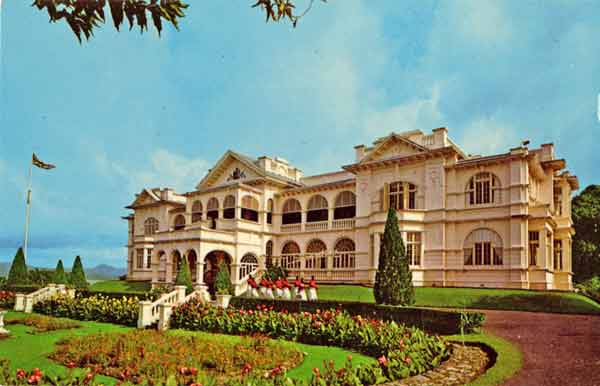 Government House, Suva. Photo courtesy of Wikipaedia.
Both sides exercised self-restraint in the incident. The protestors stood silently and brandished placards opposing the 2013 constitution. The police moved in and carried out the arrests without incident, and treated those detained with civility. In doing so both sides made their respective points.
There will be more such interplay in the months ahead. The pace and intensity of the interplay between government and opposition can be expected to increase in the build up to election day and in the immediate aftermath of the results being made public. The way in which the process unfolds will be critical to the ultimate outcome, be it the holding of successful elections, another postponement, or annulment of the results.
The key to a successful transition to elected government and the eventual restoration of full democracy is for moderates on each side (regime supporters and regime opposition) to dominate the interaction between regime and opposition in the lead-up to the voting date. But that is not a given, since both sides can roughly be divided into hard liners and soft liners.
The hard liners in the Baimimarama regime are its core adherents who do not wish to see a transition. They are members of the military and civilian bureaucracy whose personal and professional fortunes rest on the continuation of authoritarian rule (including grants of legal immunity for their actions during the authoritarian era). That could include Commodore Baimimarama himself, who may see elections as a way of cloaking the prolongation of his rule in a mantle of popular legitimacy.Hardliners in the opposition are those who have been directly affected by the regime’s repression and political exclusion. They include political party and church leaders, unionists and tribal elites who were the focus of military-bureaucratic sanctions. These individuals and groups want to see Commodore Baimimarama and other authoritarian leaders face trial for alleged crimes committed under their rule.
The soft-liners who support the authoritarian regime applaud what it has done in office but feel the time has come for power to be shared with broader elements in Fijian society. These include business elites, civil servants, diplomats and selected interest groups. They do not feel as personally or professionally vulnerable to a change of regime.
The soft-liners in the opposition are those who have not been directly affected by repression and who see the need to exercise caution when approaching the subject of post-authoritarian justice. They have less of a personal stake in retribution or punitive sanction of Baimimarama and his cohort and more interest in moving incremntally forward towards fuller restoration of civil liberties and political rights.
Foreign actors also have different perspectives on the transition. Many international organizations, private entities and foreign governments want a full restoration of democracy at the earliest possible opportunity. Others are indifferent when it comes to the transition and prefer the stability offered under current conditions than the uncertainty of a return to the politics of yore. For the latter concerns about their stake in Fiji in the event of regime change outweigh concerns about the current nature of it.
These actors are more prone to accept the continuity argument of regime hardliners, whereas the former are more likely to subscribe to the views of opposition hardliners that a full immediate break with the Baimimarama era is required. Here again, they key to a successful transition to mass-based elected rule is for the foreign interlocutors to align their views with the moderates on both sides of the Fijian political divide. That will require the negotiation of post-election guarantees amongst them.
Strategically speaking, for the Fijian transition to lead to the restoration of legitimately elected popular government, soft-liners on both sides will need to negotiate political compromises on core policy and legal issues while marginalizing their respective hardliners. They will need to initiate these conversations prior to the election date and honor whatever promises made after it.
The hardliners will not, by virtue of their positions, speak to each other. But they could dominate the internal discussions within each camp.Consequently, the first order of business for those who wish to see a genuine transition to accountable elected rule is to sideline the extremists/militants/hardline elements within their respective camps. The biggest problem in doing resides in not giving the appearance of selling out to the other side, which will be the first claim made by hardliners within and against the Baimimarama regime. They key to succeeding in this task is to separate the individual fortunes of individuals from those of institutions and agencies charged with running the country in the future.
Should soft-liners or moderates be successful in dominating the approach to the transition on each side of the Fijian political divide, then the issue of mutual guarantees and political compromises can be broached.
The political compromises required to ensure that the transition to elected rule happens on time and as scheduled can be divided into procedural and substantive in nature. The former involve the terms and conditions under which the elections are held and results accepted by all parties. These start with the regime’s proposed timetable and rules for participation, and end with an agreement to accept the results as binding. The path from one to the other is not written in stone and will be the first order of business for all interested in participating.
If procedural compromises can be agreed upon, then substantive compromises can be negotiated about issues of post-authoirtarian policy. This will include the extent, if any, of prosecutions for misdeeds committed during the authoritarian era as well as the compensation offered for those victimized by it (and the trade-offs they may entail). They will include discussion of core economic and investment issues (including the issue of guarantees for investors and agents favored by the dictatorship) as well as foreign policy and post-authoritarian civil-military relations. There are other substantive issues likely to be tabled but these will be the core sticking points for the post-authoritarian political system.
Conclusion.
The outcome of the Fijian political transition scheduled for 2014 is uncertain at the moment. 36th Parallel Assessments is positioned to offer forecasts and targeted advice on the transition process, including analysis of the procedural and substantive terms and individuals and entities involved in it. These services will be of particular value to potential stakeholders and interested parties, including institutions, investors and other potential interlocutors.
** 36th Parallel Assessments is a non-partisan, non-governmental political
risk and strategic assessment consultancy. It combines open source
intelligence sharing, qualitative analysis and discrete fact-finding
with a focus on Australasia and the South Pacific. http://36th-parallel.com
Subscribe to:
Posts (Atom)